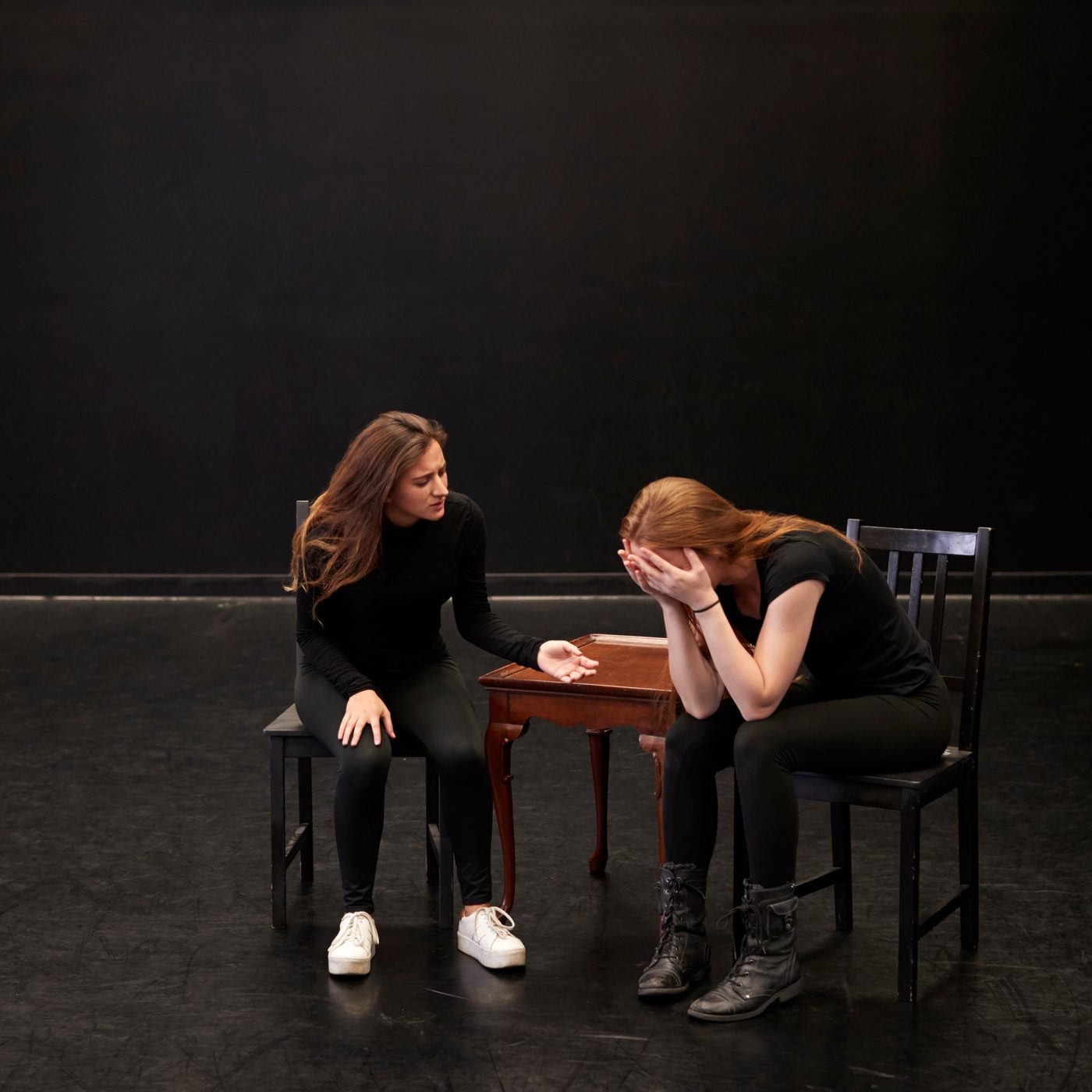
Before SLEducation existed, before I'd ever written a session plan around social communication, I worked a half-and-half schedule — part of my week as a drama teacher, the other part in special education. My background is in Drama first, but by the time I was teaching, the two were already running side by side.
Drama had done something for me long before I taught it. When I was younger, it was drama that built my own confidence — not because I got everything right, but because in improv, mistakes are simply allowed. There's no getting a line wrong, no failing a scene. You make a choice, it doesn't land the way you expected, and you just keep going. Over time, that changes how you feel about getting things wrong in general — it stops feeling dangerous.
It was working across both classrooms in the same week that I first noticed something I couldn't quite explain at the time.
The quiet students — the ones who barely spoke in other lessons — would open up. And the students on the autism spectrum, who often found unstructured social situations difficult, would often become more confident the moment they were playing a role.
At first, this seemed like a contradiction. Wasn't improvisation supposed to be the hardest kind of social task — unscripted, unpredictable, no safety net? Shouldn't scripted, rehearsed exercises feel safer for students who found spontaneous social interaction difficult?
But the pattern held, class after class, student after student.
Why it worked
The answer, I eventually realised, wasn't that improvisation removed structure. It was that it combined structure with spontaneity — rather than forcing a choice between the two.
Every improvisation exercise still had a clear frame: a scenario, a role, a starting point, a purpose. Nothing was left completely open. But within that frame, what happened next wasn't predetermined. There was no "correct" line to remember, no risk of forgetting your part, no single right answer to get wrong.
That combination mattered enormously. Pure structure — like a script — asks a student to reproduce something exactly, which creates pressure to be "correct" and does nothing to prepare them for the moment a real conversation goes somewhere the script never covered. Pure spontaneity, with no structure at all, is simply too unpredictable and overwhelming to be a safe starting point for building a new skill.
Improvisation sits between the two. It gives a student enough structure to feel safe, and enough spontaneity to actually practise responding to the unexpected — which is, after all, what real conversations demand.
A word on masking
For many autistic students, everyday social situations already demand a kind of performance — consciously suppressing natural responses, rehearsing "normal" behaviour, monitoring themselves constantly to fit in. This is often called masking, and it's exhausting precisely because it's involuntary and unrelenting.
Playing a role in improvisation is different. It's performance too, but it's performance with permission — a role the student has knowingly stepped into, that they can step back out of, with no pretence that it's really "them." That distinction seemed to matter enormously. Instead of the constant, hidden effort of masking to seem typical, students got to occupy an openly fictional role, and paradoxically, that gave several of them the safety to be far more themselves than usual.
I don't think it's a coincidence that some of the least masked, most natural responses I saw from autistic students happened while they were technically "pretending" to be someone else.
From the classroom to SLEducation
That pattern — quiet students opening up, autistic students growing more confident inside a role — is the reason SLEducation is built the way it is. Every session begins with clear, explicit teaching (the structure), followed by live improvisation practice (the spontaneity), never one without the other.
It's not a technique I designed in the abstract. It's one I watched work, repeatedly, long before I had a name for why.