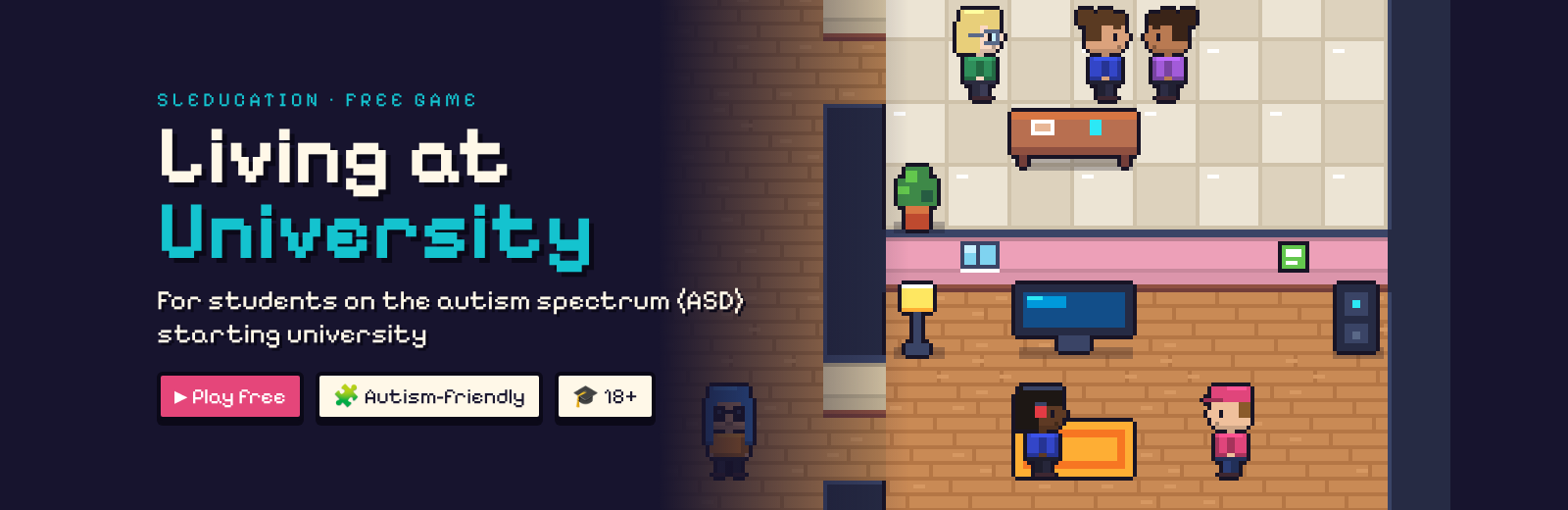
When people hear that I make games, the next question is usually some version of: "But do games actually teach anything?" It's a fair question, and one I took seriously before I built a single level.
Over the past few months I've made four free games for SLEducation: Dating Safely for online dating safety, Interview Ready for job interviews, Navigating the Workplace for your first week at work and, most recently, Living at University, where you move into a shared flat and get through your first term. Here's why I use games, what the research says, and where I think they stop being enough.
It started in the drama studio
The idea isn't really new for me. Before SLEducation, I taught Drama at an international school in Macau alongside my work in special education, and I noticed the same thing class after class: students on the autism spectrum often became more confident the moment they were playing a role. A role gave them a clear frame, and permission to get things wrong. In improv, getting things wrong is simply part of it.
A well-designed game does something very similar. It gives you a clear situation, a role to step into and a goal, then lets you make a choice and see what happens. If it doesn't go well, nothing is lost. You just try again.
What the research says
Gamification means borrowing elements from games, such as points, levels, progress bars, a story and instant feedback, to make learning more motivating. A serious game goes a step further: the whole thing is a game, but it's built to teach. My games are serious games, and the research behind them is more encouraging than many people expect.
A large meta-analysis found that gamified learning has small to medium positive effects on what people learn, how motivated they feel and how they behave, but mainly when the game elements are well designed and tied to the learning rather than added on top.[1]
For autistic learners, a review of serious games for social skills and emotion recognition found positive results in many studies, particularly for recognising emotions.[2] And it isn't only children. Autistic adults who practised reading complex emotions in faces and voices with interactive software got better at it.[3] Young adults who practised social situations in a virtual environment improved in emotion recognition and conversation.[4] Adults who practised job interviews with a virtual interviewer performed better and felt more confident in mock interviews.[5]
The study I found most useful, though, looked at what makes these games work. Many games designed for autistic people weren't very motivating, and the researchers recommended learning from commercial games and planning for real-life use from the very beginning.[6] That shaped a lot of my decisions.
How that shapes my games
Every choice gets clear, literal feedback straight away: what happened and why, with nothing left to read between the lines. Most questions have more than one good answer, because real conversations rarely have a single right line, and after each choice the game shows you the other good options too. It's the same reason I don't use scripts in my sessions.
Facial expressions and tone of voice are written out alongside what each character says, so players can connect the clue to the meaning, including sarcasm and idioms. Every game has a 🌿 calm button with breathing and grounding, and Living at University has a sensory meter that rises in noisy places, or when you choose to mask. How much energy a situation takes matters just as much as what you say in it.
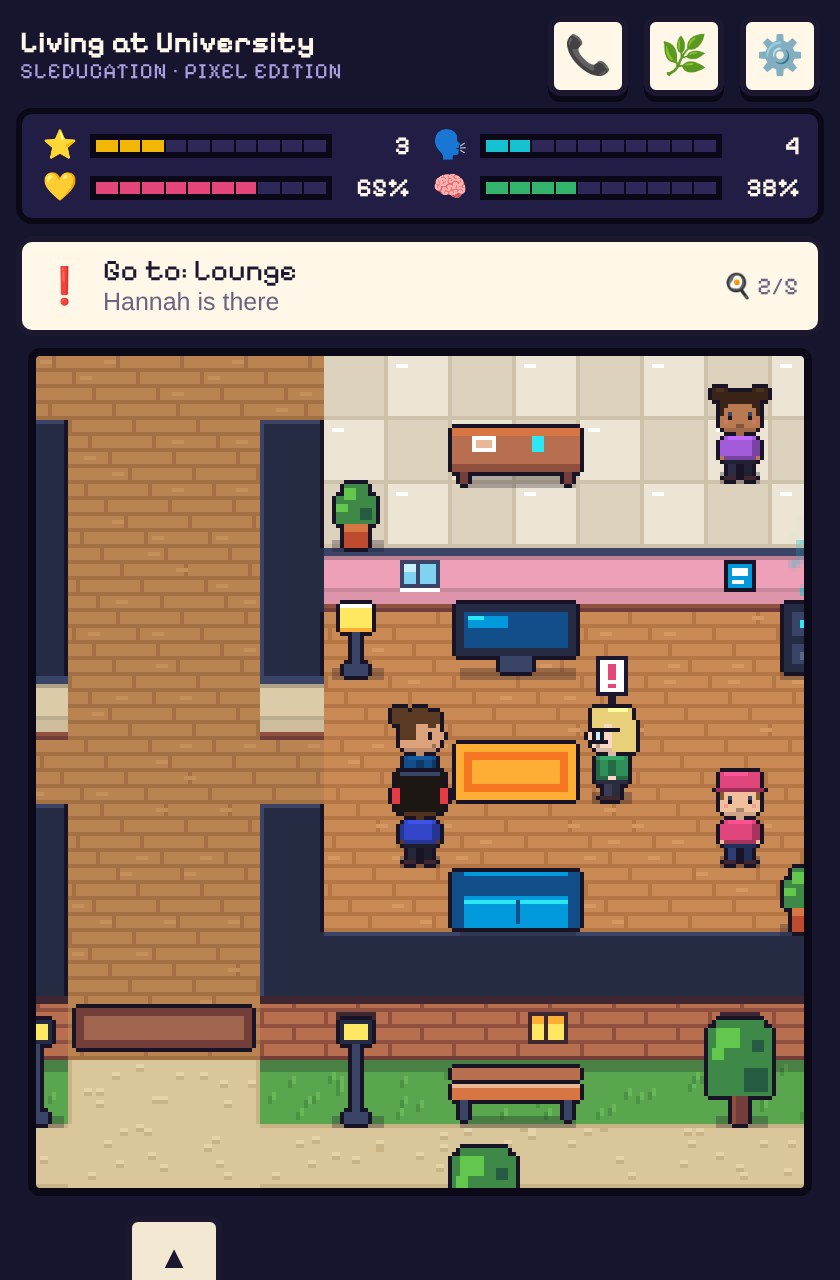
Living at University: the meters show progress at a glance, and the ❗ shows exactly where to go next.
I've also tried to work with how attention often works for autistic people. Monotropism describes a tendency to focus deeply on a small number of things at a time,[7] so there's one clear task on screen and a ❗ showing where to go next. Living at University even asks about your special interest at the start and builds it into your term.
Finally, the games are free, need no account and save only on your own device. You can play at your own pace with no one watching, which matters when you're practising something that feels awkward.
Where games stop being enough
I want to be honest about the limits. The hardest part of learning any social skill is generalisation: using it in real life, with real people, when your heart is racing.[2][3][6] A game can show you what a pressure tactic sounds like, or how to email a lecturer. Doing it for real is a different thing.
That's why I see the games as a first step, not the whole journey. In my one-to-one sessions, we take the same situations and practise them live through improvisation, then plan how to use them in your own flat, workplace or next date.
Try the games
All four games are free to play in your browser on a phone, tablet or computer.
References
- Sailer, M. & Homner, L. (2020). The gamification of learning: A meta-analysis. Educational Psychology Review, 32, 77–112. doi.org/10.1007/s10648-019-09498-w
- Grossard, C. et al. (2017). Serious games to teach social interactions and emotions to individuals with autism spectrum disorders (ASD). Computers & Education, 113, 195–211. hal.sorbonne-universite.fr/hal-01525828
- Golan, O. & Baron-Cohen, S. (2006). Systemizing empathy: Teaching adults with Asperger syndrome or high-functioning autism to recognize complex emotions using interactive multimedia. Development and Psychopathology, 18(2), 591–617. doi.org/10.1017/S0954579406060305
- Kandalaft, M. R. et al. (2013). Virtual reality social cognition training for young adults with high-functioning autism. Journal of Autism and Developmental Disorders, 43(1), 34–44. doi.org/10.1007/s10803-012-1544-6
- Smith, M. J. et al. (2014). Virtual reality job interview training in adults with autism spectrum disorder. Journal of Autism and Developmental Disorders, 44(10), 2450–2463. pmc.ncbi.nlm.nih.gov/articles/PMC4167908
- Whyte, E. M., Smyth, J. M. & Scherf, K. S. (2015). Designing serious game interventions for individuals with autism. Journal of Autism and Developmental Disorders, 45(12), 3820–3831. pure.psu.edu
- Murray, D., Lesser, M. & Lawson, W. (2005). Attention, monotropism and the diagnostic criteria for autism. Autism, 9(2), 139–156. monotropism.org
