Many of the teens and adults I work with describe the same pattern. They manage at school, university or work for weeks or months. They look fine to everyone around them. Then, suddenly, they cannot do things they could do before: replying to messages, getting out of bed on time, even speaking in a meeting. Often, nobody around them understands why.
This is often autistic burnout, and one of the biggest causes is masking. This article explains both in plain language, lists the early warning signs, and shows what helps. At the end, there is a free game where you can practise planning a week of energy.
What is masking?
Masking (also called camouflaging) means hiding or changing autistic traits so that you fit in. In a study of 92 autistic adults, people described many ways of masking:[1]
- Forcing eye contact, even when it feels uncomfortable.
- Stopping themselves from stimming (for example, rocking or moving their hands).
- Copying other people's facial expressions, body language or words.
- Rehearsing conversations and preparing topics before social events.
- Asking other people lots of questions, so that the focus stays off themselves.
People in the study said they masked to fit in, to avoid bullying, to make friends and to get jobs. These are understandable reasons. But the most common result was exhaustion. Many people said masking was mentally and physically draining, and that they needed time alone to recover afterwards.[1]
What is autistic burnout?
Researchers worked with autistic adults to define autistic burnout. They describe it as long-lasting exhaustion, a loss of skills, and lower tolerance for sensory input such as noise and light.[2] A second study, also based on autistic people's own experiences, describes exhaustion, withdrawing from people, and problems with executive function (planning, organising and starting tasks). Autistic traits can also become stronger during burnout.[3]
Both studies found that autistic burnout is different from depression and different from ordinary work burnout.[2][3] This matters, because the support that helps is not always the same.
Why does it happen?
A simple way to think about it is an energy budget. Every day, things use energy: travelling, noise, changes of plan, social events and masking. Other things give energy back: sleep, quiet time, special interests and being with people you feel safe with.
In the research, burnout happened when life's demands were more than a person's abilities and energy for a long time, and there was not enough support to reduce the load.[2] Masking adds to the load every day, often without anyone noticing, including the person who is masking.
Early warning signs
Burnout usually builds slowly. These signs can show that energy is running low:
- Feeling tired even after a full night's sleep.
- Noise, light or crowds feeling much harder to cope with than usual.
- Finding it hard to speak, reply to messages or find words.
- Skills that were easy before (cooking, planning, travelling) suddenly feeling difficult.
- Wanting to stay away from people, even people you like.
- More meltdowns or shutdowns than usual.
Noticing these signs early gives you a chance to reduce demands before you reach burnout.
What helps
In the research, the things that helped most were acceptance and support from other people, time off, fewer expectations, and being able to do things in an autistic way, which means masking less.[2] In practical terms, that can look like this:
- Plan recovery time into the week, especially after busy or social days, instead of waiting until you are exhausted.
- Ask for adjustments. For example, written instructions, noise-cancelling headphones at work, a quiet room, or the agenda before a meeting. One adjustment can save energy every day.
- Choose where to mask less. Masking is not always a free choice, but many people find some places and people where they can relax and be themselves.
- Protect sleep and special interests. These give energy back.
- Stay connected. Withdrawing completely can make recovery harder. A short message to one safe person still counts.
If you think you or your child may be in burnout, or you are worried about low mood, please speak to a doctor or another qualified professional. My sessions are educational and can sit alongside that support.
Practise with the Energy Budget game
I made Energy Budget so people can see how energy and masking work over a whole week, without the real-life cost. You move through a week at college or work. Every event uses or gives energy. Masking fills a separate track, and if it reaches the red zone, the risk of burnout goes up. Asking for adjustments gives you cards that make the rest of the week easier.
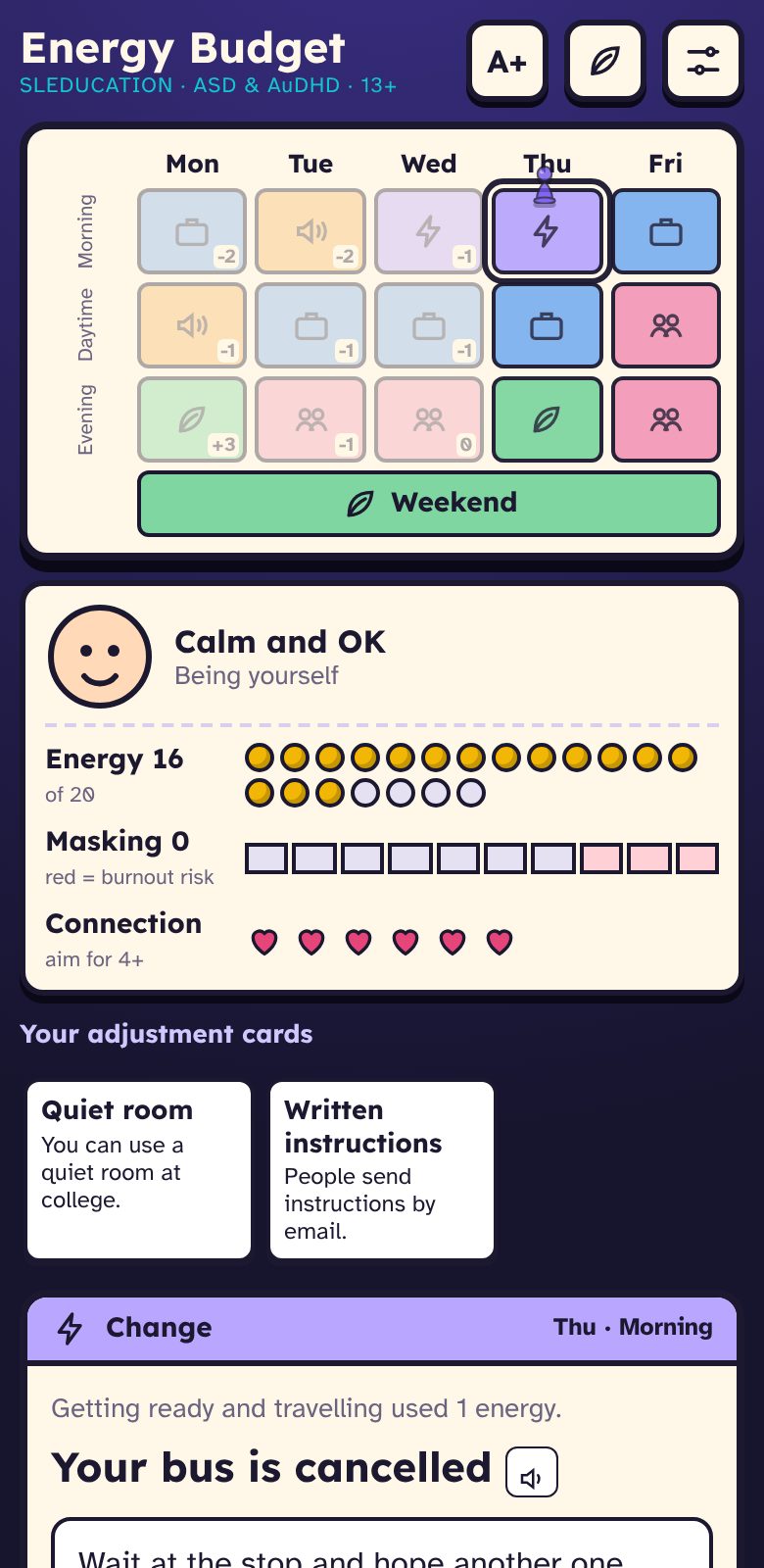
Energy Budget: plan your week, watch your energy and masking, and collect adjustment cards.
There are three weeks to play: a college week, a work week in a busy open-plan office, and a harder "Burnout Warning" week where you start already tired. The goal is not to "win" by doing everything. The goal is to finish the week with energy left, masking out of the red zone, and still connected to people.
References
- Hull, L. et al. (2017). "Putting on my best normal": Social camouflaging in adults with autism spectrum conditions. Journal of Autism and Developmental Disorders, 47(8), 2519–2534. doi.org/10.1007/s10803-017-3166-5
- Raymaker, D. M. et al. (2020). "Having all of your internal resources exhausted beyond measure and being left with no clean-up crew": Defining autistic burnout. Autism in Adulthood, 2(2), 132–143. doi.org/10.1089/aut.2019.0079
- Higgins, J. M. et al. (2021). Defining autistic burnout through experts by lived experience: Grounded Delphi method investigating #AutisticBurnout. Autism, 25(8), 2356–2369. doi.org/10.1177/13623613211019858
