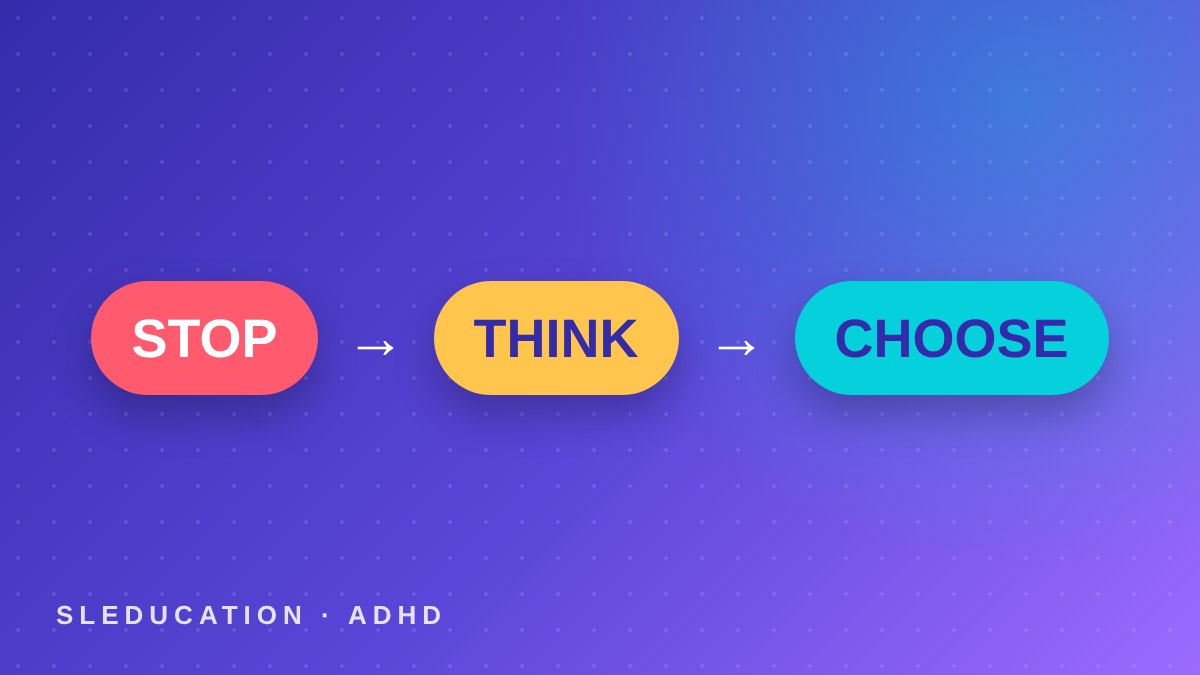
Ask most people with ADHD whether they should think before they speak or act, and they'll say yes, of course. The difficulty is that the moment passes before the thinking starts. The comment is already out. The message is already sent. The controller has already been thrown.
The Stop-Think strategy is a way of creating a small gap in that moment. It's at the centre of my ADHD sessions, and it's one of the main things we practise through improvisation.
Where the strategy comes from
The idea of teaching people to talk themselves through a problem goes back to the early 1970s. Donald Meichenbaum and Joseph Goodman showed that impulsive children could be taught to use step-by-step self-talk, first out loud and then silently, to slow down and work through tasks more carefully.[1] Philip Kendall and Lauren Braswell later built this into a structured cognitive-behavioural programme for impulsive children, using "stop and think" self-instructions.[2]
The version I use is adapted for teens and adults, and kept deliberately short so it can be used under pressure.
The steps
Stop. Notice the signal: the rush of frustration, the urge to interrupt, the pull of something more interesting. Pause, even for a second. Some people use a breath, a word, or a small physical cue.
Think. What is actually happening? What are my options? What will happen if I do each one?
Choose. Pick the option that fits what you want, then do it.
Check. Afterwards, ask: did I stop? How did it go? What would I keep or change?
Why knowing the steps isn't enough
The steps are easy to learn. Using them when you're frustrated, excited or distracted is the hard part. That's why I don't just teach Stop-Think as a poster on the wall. We practise it live, at the moment it's needed.
How I practise it in sessions
Scenes with built-in triggers. We improvise short scenes that include something to stop for: a classmate teasing, a parent asking for the third time, a manager changing plans at the last minute, a notification during revision.
Freeze and rewind. At the impulsive moment, we pause the scene. The individual talks through Stop-Think out loud, then we replay the moment using their chosen response. The replay is where the learning happens.
From slow to real time. Early scenes are slow and exaggerated, so there's plenty of time to stop. As confidence grows, the scenes speed up until the response starts to feel automatic.
Quick self-rating. After each scene, a fast check: did I stop, what did I think, what did I choose? This builds self-monitoring, which is a skill in its own right.
A short example
In one scene, I might play a younger sibling who keeps changing the TV channel while the individual is watching something. The first run usually ends in an argument, which is fine. We freeze it, talk through the options (walk away, ask a parent, agree on turns, use headphones), choose one, and run the scene again. By the third or fourth take, the pause is getting quicker.
Later, the individual might bring a real version of this from their week. That's the Take 2 part of the session.
