Before SLEducation, a large part of my work was as a case manager and in a pupil referral unit. Many of the students I supported there had ADHD. Very few of them lacked ability. What they lacked was a reliable way to get started, keep track of time, and pause before reacting in the moment that mattered.
ADHD was also part of my Master's degree and my professional development, and it is now one of my two specialisms, alongside ASD. This post explains how I work with teens and adults with ADHD, and why my approach is CBT-informed.
Knowing what to do is rarely the problem
Ask a teenager with ADHD what they should do when they have an essay due tomorrow, and most will give you a sensible answer. Start early, turn off the phone, break it into parts. The difficulty is doing it, at the right time, without someone standing next to them.
The psychologist Russell Barkley describes ADHD as a difficulty with doing what you know, rather than knowing what to do.[1] His model places self-regulation and the executive functions at the centre of ADHD: the brain skills that let us stop, hold a plan in mind, manage time and steer our own behaviour.[1]
This matters for how I teach. If the problem were knowledge, a worksheet would fix it. Because the problem is performance in the moment, the skill has to be practised in the moment.
What "CBT-informed" means, and what it doesn't
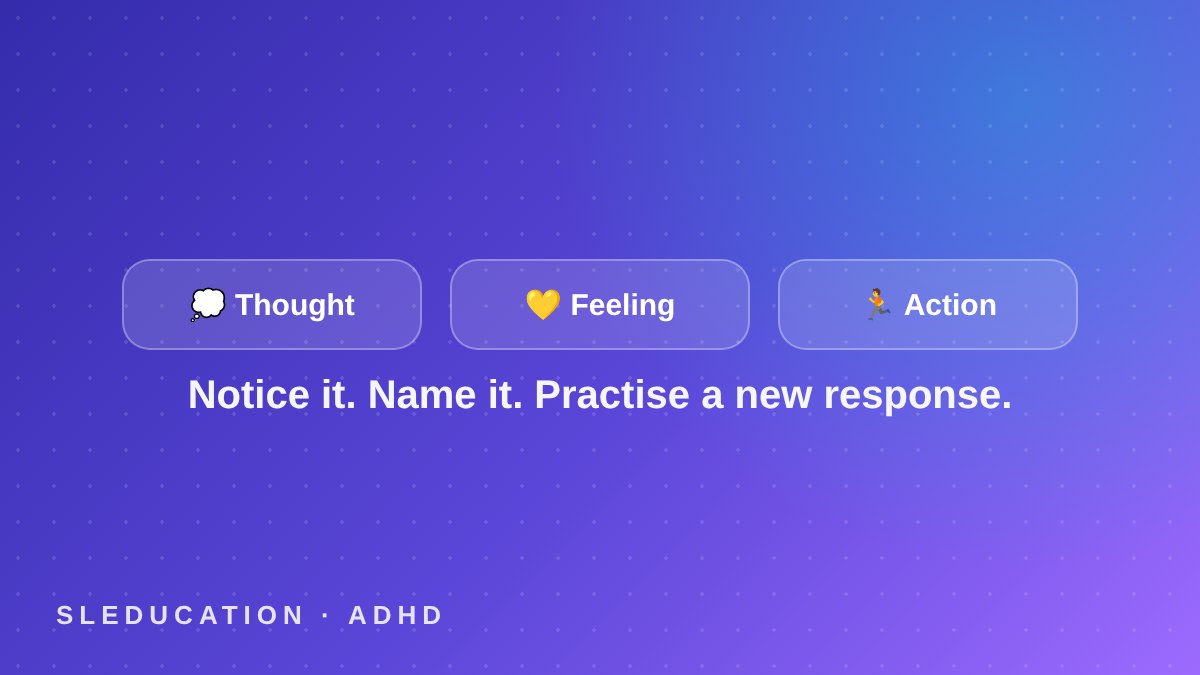
Cognitive Behaviour Therapy (CBT) looks at the links between thoughts, feelings and actions. For ADHD, that often means noticing thoughts like "I'll do it later" or "there's no point starting now", seeing how they lead to avoidance, and building practical routines and self-talk to break the pattern.
I have CBT training, and I use strategies drawn from it. But I want to be clear: my sessions are educational support, not CBT therapy. I don't diagnose, and I don't treat mental health conditions. If someone needs clinical support, I'll always recommend speaking to a qualified clinician, and my sessions can sit alongside that support.
The research behind CBT-style approaches for ADHD is encouraging. A randomised controlled trial with adults whose symptoms continued despite medication found that CBT led to greater improvement than relaxation and education alone.[2] A similar trial with medication-treated adolescents also found benefits.[3] In the UK, the NICE guideline on ADHD includes CBT as an option for young people and adults.[4]
How a session works
Every session follows the same clear structure, which helps with focus and keeps things predictable.
1. Teach the thinking behind the skill. We look at one executive function skill, such as task initiation or time management. I explain why it's hard, what usually gets in the way, and one or two strategies to try. I keep it concrete and visual, with no long lectures.
2. Practise it out loud. This is where my drama background comes in. We use short improvised scenes with built-in triggers: a friend messaging while you're revising, a teacher giving three instructions at once, a game you don't want to stop. The individual practises the Stop-Think strategy live, out loud, at the moment it's needed. Scenes start slow and get closer to real speed as confidence grows.
3. Take 2. Towards the end of a session, the individual can bring a real situation from their week and replay it. We find the moment where they could have stopped, try a different response, and agree one thing to try next time. I've written more about this in "Take 2": Replaying Real Situations.
A written feedback report follows within 48 hours, so parents and the individual can see what was practised and what to work on at home.
Why practise instead of just talk?
Talking through a strategy is useful, but it happens in a calm room, after the moment has passed. Improvisation brings the moment into the session. The individual feels a small, safe version of the pressure, interruption or frustration, and practises responding while it's happening.
It's also more engaging. For many people with ADHD, a session that moves, changes and involves them directly is far easier to stay with than a discussion. And because improv treats mistakes as part of the process, there's room to get it wrong and try again without shame.
Who this is for
My ADHD sessions are for teens and adults aged 13 and above, with or without a formal diagnosis. Individuals with both ASD and ADHD can combine topics from both areas. You can see the course options on my Services page.
