"Executive function" comes up a lot in conversations about ADHD, but it's rarely explained clearly. This guide covers what it is, what it looks like day to day, and how you can help at home.
What is executive function?
Executive functions are the mental skills we use to manage ourselves: to stop and think, hold information in mind, plan, switch between tasks and adapt when things change. Researchers often describe three core executive functions: inhibitory control (stopping yourself), working memory (holding information while using it) and cognitive flexibility (shifting your thinking).[1] More complex skills like planning and problem-solving are built on these.
A helpful way to explain it to a teen is that executive function is the brain's management team. With ADHD, the team is just as capable, but it's often short-staffed at the moment it's needed.[2]
The ten skills I work on
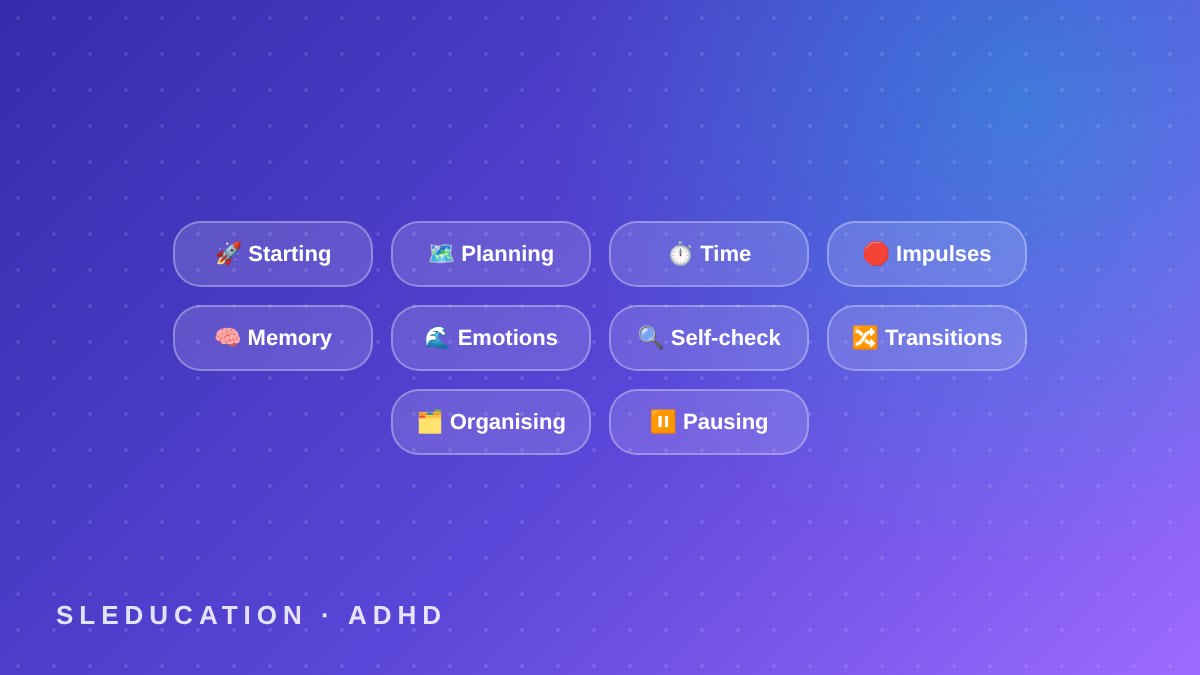
My ADHD courses cover ten executive function topics. Here's what each one can look like at home:
Task initiation: knowing homework needs doing but not being able to start.
Planning and prioritisation: spending an hour on the easy part and leaving the important part.
Time management: genuinely believing a task will take ten minutes when it takes an hour.
Procrastination: "I'll do it later" turning into "I'll do it tomorrow".
Impulse control: blurting out, interrupting, or reacting before thinking.
Working memory: forgetting the second and third instruction.
Emotional regulation and flexibility: big reactions when plans change.
Self-monitoring: not noticing a task has gone off track until it's too late.
Transitions: real difficulty stopping a game or switching to a new activity.
Organisation: lost PE kits, chaotic bags, forms that never come home.
The Short Course (Basics) covers the first five, and the Extended Course covers all ten. You can find details on my Services page.
"Lazy" is usually the wrong word
When a capable teen repeatedly doesn't do something, it's easy to read it as not caring. More often, they care a great deal and feel frustrated with themselves. Years of being told to "just try harder" can leave many young people with ADHD feeling that they are the problem. Naming the specific skill that's struggling ("starting is hard for you") is usually far more helpful than a general judgement.
How to help at home
Make it external. Checklists by the door, visual timers, phone alarms and a shared calendar take pressure off working memory and time sense.
Fewer reminders, clearer cues. One written list beats ten verbal reminders, which often blur into background noise.
Help with the first step only. Sitting nearby for the first five minutes of homework can be enough to get past the start.
Notice when it works. Point out the times they did stop and think, or did start on time. It builds the habit and the confidence.
One goal at a time. Pick one skill to focus on for a few weeks, rather than everything at once.
If you'd like to see how I practise these skills in sessions, read My CBT-Informed Approach to Executive Function Support.
