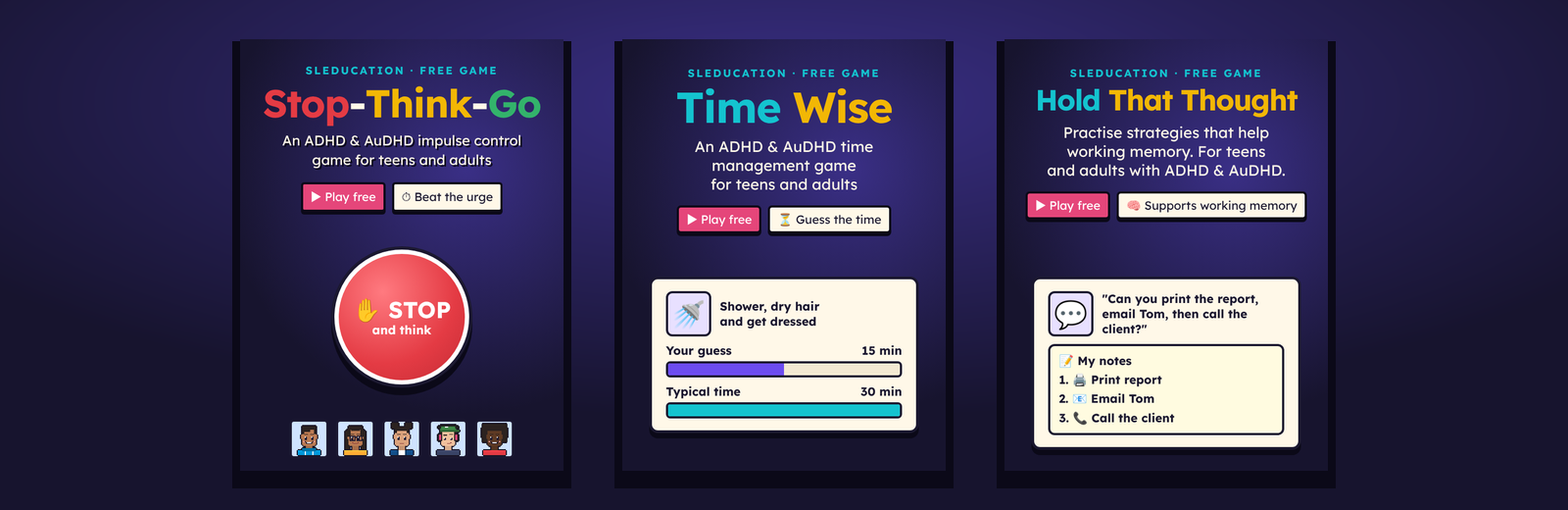
When I started building games for teens and adults with ADHD and AuDHD (autism and ADHD together), I set myself one rule: every game has to practise something that helps in real life, and I have to be able to explain why. This page sets out the research behind Stop-Think-Go, Time Wise, Remember the Steps and Just Start, including where the evidence is strong and where it isn't.
Strategies, not "brain training"
You may have seen apps that promise to "train your brain" by remembering longer and longer lists. The research on this is fairly clear. A large meta-analysis found that working memory training makes people better at the training tasks and similar tests, but those gains don't carry over to wider skills.[1] A meta-analysis of cognitive training for ADHD found the same pattern: working memory scores went up, but when the people rating ADHD symptoms didn't know who had been trained, the effect on symptoms was small.[2]
What does have good evidence for adults with ADHD is learning practical strategies. In a randomised trial, adults who had CBT that taught organisation and planning, ways to cope with distraction and more helpful thinking did better than those given relaxation and education: 67% responded on an ADHD rating scale, compared with 33%, and the gains lasted a year.[3]
So my games don't try to make anyone's memory or attention "bigger". They give players a safe place to practise the strategies I teach: pausing before acting, checking how long things really take, writing things down and breaking jobs into tiny first steps.
Stop-Think-Go: impulse control
Research consistently finds differences in how quickly people with ADHD stop an action once it has started. A meta-analysis of the stop-signal task found that children with ADHD were slower to stop, a medium-sized difference, although the authors noted this may partly reflect slower responses in general.[4]
The Stop-Think approach goes back to self-instructional training, where people learn to talk themselves through a task: stop, think about the options, then act.[5] The same idea runs through CBT for ADHD. In the game, an urge appears with a timer, and the player decides whether to stop or act. Some moments are deliberately "Go" moments, like turning off a smoking pan or saying thank you, because the real skill isn't stopping everything. It's knowing when a pause is needed.
Time Wise: time management
People often describe ADHD as "time blindness", and the research supports a real difference. A meta-analysis of 27 studies found that children and adolescents with ADHD judged time less accurately and less precisely than their peers.[6] On top of that, almost everyone underestimates how long tasks will take, a well-known effect called the planning fallacy.[7] Put the two together and getting out of the door on time becomes genuinely hard.
Time Wise asks players to guess how long everyday tasks take, then shows a typical time and the "hidden steps" people forget. A "My time sense" card shows whether each player tends to guess too short or too long, because the direction differs from person to person. The Leaving on Time and Busy Mornings levels practise planning backwards from an arrival time and adding a buffer for surprises, the kind of planning skills taught in CBT for ADHD.[3] The times in the game are typical examples, not rules. The real goal is for players to start timing themselves.
Remember the Steps: working memory
Following multi-step instructions relies heavily on working memory. In one study, children with ADHD remembered fewer steps from multi-step instructions than their peers.[8] In everyday life, that might look like forgetting the third thing a manager asked for, or the last part of a lecturer's instructions.
Rather than trying to stretch memory, the game teaches cognitive offloading: using the outside world to reduce the load on memory, such as writing a list or setting a reminder.[9] Before each instruction, players choose a tool: write it down, say it back, ask again, or just remember. The game then shows which tools worked best for them. Writing distracting thoughts down to deal with later is also part of the CBT approach mentioned above.[3]
Just Start: getting started on tasks
Putting things off isn't laziness. A large meta-analysis of procrastination found that people put off tasks most when the task feels unpleasant, when the deadline or pay-off is far away, and when they are more impulsive.[12] ADHD research adds a related idea: many people with ADHD find waiting for a delayed reward especially hard, sometimes called delay aversion.[13] A boring job with a distant pay-off is the hardest kind of job to start.
The game practises three strategies. First, make it smaller: players pick a tiny, concrete first step, such as "open the document and type the title" rather than "write the essay". In later levels, one option is a trap that feels useful but delays the real job, such as making a colour-coded revision timetable instead of revising. Planning exactly what you will do, and when, is called forming an implementation intention, and a meta-analysis of 94 tests found it had a medium-to-large effect on reaching goals, including getting started.[14] Second, pick a strategy that matches why the task feels hard: a 5-minute timer for jobs that feel endless, music or a podcast for boring ones, a reward for jobs with no pay-off today, a rough first draft when you're worried about getting it wrong, clearing your phone away, or body doubling, working alongside someone else. Body doubling is popular in the ADHD community, and a survey of 220 neurodivergent adults described how it helped them start, keep going and finish tasks. The research is still early.[15] Third, save it for later: when a distraction appears, players decide whether it can wait and be written down for later, or whether it really needs dealing with now. Writing distractions down to deal with later is part of the CBT approach mentioned above.[3]
Plan My Week: planning and prioritising
Planning is an executive function skill: it means looking ahead, guessing how long jobs take, and choosing what matters most. Many people with ADHD find this hard, and often plan every hour with no spare time, so one surprise pushes everything back. The game uses strategies from the CBT approach for adult ADHD mentioned above: keeping one planner, sorting jobs by importance, and breaking big jobs into smaller steps.[3] Planning exactly when you will do each part is also an implementation intention, which helps people start and finish goals.[14]
Players put sticky-note jobs into a paper planner, split big jobs into 1-hour parts, leave empty hours, and choose what to leave for next week. Then the week plays out with surprises, such as losing your keys or doing overtime, and each plan is marked on six simple rules. In the exam level, revising a little on several days is rewarded, because spreading practice out works better than one long session.
Stay Focused: handling distractions
ADHD is not a lack of attention. It is difficulty controlling where attention goes: interesting things pull attention away, and it can be hard to get back to the task afterwards. The opposite can also happen. In hyperfocus, attention locks onto something interesting so strongly that time, food and other people are forgotten.
The game practises a quick three-way decision for each distraction: ignore it, write it down for later, or deal with it now if it is urgent. Writing distracting thoughts down to deal with later is part of the CBT approach for adult ADHD mentioned above.[3] Before each level, players also set up their space with tools such as putting the phone in another room, headphones or a body double. Changing the environment is a common ADHD strategy, because it stops distractions before they start, instead of relying on willpower. The hyperfocus level practises noticing signals that mean it is time to stop.
Handle Strong Feelings: emotional regulation
Strong, fast feelings are a common part of ADHD, even though they are not in the official diagnostic criteria. A major review described emotional dysregulation as a core feature for many people with ADHD,[16] and a meta-analysis of studies with adults found that adults with ADHD reported much more difficulty regulating emotions than adults without ADHD.[17]
The game follows three steps: notice, pause, respond. Players first name the feeling from body signs and thoughts. In a brain-imaging study, putting a feeling into words reduced activity in the amygdala, a part of the brain involved in strong emotional reactions. This is called affect labelling.[18] Players then choose a pause, such as slow breathing, leaving the room for 5 minutes or putting a problem aside until they feel calmer, and watch a feeling meter go up or down. The Fact or Guess? level practises checking thoughts after possible rejection, which is a core CBT skill.[3] Later levels practise overwhelm, apologising after a strong reaction, and three-step situations with more pressure. Players can build a Calm Plan of their own warning signs, strategies and people to talk to.
Manage Your Money: why money can be harder
Many autistic and ADHD people find money harder to manage. This is not about being lazy or "bad with money". It comes from differences in how the brain works. In a study of adults with ADHD, participants reported lower income, more debt and fewer savings than adults without ADHD. They scored lower on tests of financial decision-making and reported more impulse buying.[19] In a study of autistic adults, 45% said there had been a time when they did not have enough money for basic needs, compared with 25% of non-autistic adults.[20]
With ADHD, the main reasons are buying quickly for a fast reward, forgetting bills and dates, putting off boring paperwork, and finding it hard to save for a future that feels far away. Some people call the extra costs, such as late fees and forgotten subscriptions, the "ADHD tax". With autism, the reasons can include unwritten money rules (splitting a bill, tipping, saying no to a salesperson), trusting what people say, anxiety about phone calls and forms, paying for convenience when tired or overloaded, and fewer job opportunities.
The game does not try to change how anyone's brain works. It practises systems that make money easier: paying needs first, a simple budget, automatic payments, reminders, a 24-hour waiting rule before unplanned buys, checking subscriptions, and clear scripts for saying no to lending money or signing contracts on the spot. Like the other ADHD games, this matches the CBT approach of using outside tools instead of relying on memory.[3]
Why games at all?
A large meta-analysis found that game elements such as points, levels and instant feedback have small to medium positive effects on learning and motivation when they're well designed.[10] For ADHD specifically, a randomised trial of a video game-style digital treatment for children found improvements on a computerised attention test compared with a control game.[11] That trial was funded by the company that made the game, and it measured attention on a test rather than in everyday life, so it's a promising sign rather than proof.
I've written more about games and learning in Why I Use Games to Teach Social Skills. For players with ADHD, I've kept the games short, visual and fast, with one tap per answer, instant feedback, streaks, read-aloud on every screen and very little text.
What the games can't do
These games haven't been tested in their own trial, and I don't claim they treat ADHD. They're free practice tools based on approaches with good evidence behind them. The hardest part of any new skill is using it in real life, when you're tired, rushed or distracted.
That's where one-to-one sessions come in. We take real situations from your week and replay them, improvising how they could go better, then plan the strategies you'll use next time.
These games are for practice and education. They are not a diagnosis or a treatment for ADHD or AuDHD. If you have questions about ADHD, speak to your doctor or a qualified professional.
References
- Melby-Lervåg, M., Redick, T. S. & Hulme, C. (2016). Working memory training does not improve performance on measures of intelligence or other measures of "far transfer": Evidence from a meta-analytic review. Perspectives on Psychological Science, 11(4), 512–534. doi.org/10.1177/1745691616635612
- Cortese, S. et al. (2015). Cognitive training for attention-deficit/hyperactivity disorder: Meta-analysis of clinical and neuropsychological outcomes from randomized controlled trials. Journal of the American Academy of Child & Adolescent Psychiatry, 54(3), 164–174. doi.org/10.1016/j.jaac.2014.12.010
- Safren, S. A. et al. (2010). Cognitive behavioral therapy vs relaxation with educational support for medication-treated adults with ADHD and persistent symptoms: A randomized controlled trial. JAMA, 304(8), 875–880. doi.org/10.1001/jama.2010.1192
- Alderson, R. M., Rapport, M. D. & Kofler, M. J. (2007). Attention-deficit/hyperactivity disorder and behavioral inhibition: A meta-analytic review of the stop-signal paradigm. Journal of Abnormal Child Psychology, 35, 745–758. doi.org/10.1007/s10802-007-9131-6
- Meichenbaum, D. H. & Goodman, J. (1971). Training impulsive children to talk to themselves: A means of developing self-control. Journal of Abnormal Psychology, 77(2), 115–126.
- Zheng, Q., Wang, X., Chiu, K. Y. & Shum, K. K. (2022). Time perception deficits in children and adolescents with ADHD: A meta-analysis. Journal of Attention Disorders, 26(2), 267–281. doi.org/10.1177/1087054720978557
- Buehler, R., Griffin, D. & Ross, M. (1994). Exploring the "planning fallacy": Why people underestimate their task completion times. Journal of Personality and Social Psychology, 67(3), 366–381. doi.org/10.1037/0022-3514.67.3.366
- Yang, T.-X., Allen, R. J., Holmes, J. & Chan, R. C. K. (2017). Impaired memory for instructions in children with attention-deficit hyperactivity disorder is improved by action at presentation and recall. Frontiers in Psychology, 8, 39. doi.org/10.3389/fpsyg.2017.00039
- Risko, E. F. & Gilbert, S. J. (2016). Cognitive offloading. Trends in Cognitive Sciences, 20(9), 676–688. doi.org/10.1016/j.tics.2016.07.002
- Sailer, M. & Homner, L. (2020). The gamification of learning: A meta-analysis. Educational Psychology Review, 32, 77–112. doi.org/10.1007/s10648-019-09498-w
- Kollins, S. H. et al. (2020). A novel digital intervention for actively reducing severity of paediatric ADHD (STARS-ADHD): A randomised controlled trial. The Lancet Digital Health, 2(4), e168–e178. doi.org/10.1016/S2589-7500(20)30017-0
- Steel, P. (2007). The nature of procrastination: A meta-analytic and theoretical review of quintessential self-regulatory failure. Psychological Bulletin, 133(1), 65–94. doi:10.1037/0033-2909.133.1.65
- Sonuga-Barke, E. J. S. (2002). Psychological heterogeneity in AD/HD: A dual pathway model of behaviour and cognition. Behavioural Brain Research, 130(1–2), 29–36. doi:10.1016/S0166-4328(01)00432-6
- Gollwitzer, P. M. & Sheeran, P. (2006). Implementation intentions and goal achievement: A meta-analysis of effects and processes. Advances in Experimental Social Psychology, 38, 69–119. doi:10.1016/S0065-2601(06)38002-1
- Eagle, T., Baltaxe-Admony, L. B. & Ringland, K. E. (2024). "It was something I naturally found worked and heard about later": An investigation of body doubling with neurodivergent participants. ACM Transactions on Accessible Computing, 17(3), 1–30.
- Shaw, P., Stringaris, A., Nigg, J. & Leibenluft, E. (2014). Emotion dysregulation in attention deficit hyperactivity disorder. American Journal of Psychiatry, 171(3), 276–293. doi.org/10.1176/appi.ajp.2013.13070966
- Beheshti, A., Chavanon, M.-L. & Christiansen, H. (2020). Emotion dysregulation in adults with attention deficit hyperactivity disorder: A meta-analysis. BMC Psychiatry, 20, 120. doi.org/10.1186/s12888-020-2442-7
- Lieberman, M. D. et al. (2007). Putting feelings into words: Affect labeling disrupts amygdala activity in response to affective stimuli. Psychological Science, 18(5), 421–428. doi.org/10.1111/j.1467-9280.2007.01916.x
- Bangma, D. F. et al. (2019). Financial decision-making in adults with ADHD. Neuropsychology, 33(8), 1065–1077. doi.org/10.1037/neu0000571
- Griffiths, S., Allison, C., Kenny, R., Holt, R., Smith, P. & Baron-Cohen, S. (2019). The Vulnerability Experiences Quotient (VEQ): A study of vulnerability, mental health and life satisfaction in autistic adults. Autism Research, 12(10), 1516–1528. doi.org/10.1002/aur.2162
